The flow net in the seepage of water through a soil medium is a network of flow lines and equipotential lines. The flow net is used to determine the seepage flow, hydro-static pressure, seepage pressure and exit gradient. A flow line or stream line in a seepage through a soil medium is defined as the path of particles of water through a saturated soil mass. The equipotential line in a seepage through a soil mass is defined as the line connecting the points of equal head of water. The direction of seepage is always perpendicular to the euipotential lines. The flow lines and equipotential line are intersecting lines at 90 degree to each other.
* The portion between any two successive flow line is known as flow channel. The potion enclosed between two successive equipotential line and successive flow line is known as field.
* The discharge (Q) passing throuh a flow net for isotropic soil is given by :
Q = KH * Nf/Nd
K = A constant
H = Total Hydraulic Head causing flow
Nf = number of flow channels
Nd = Number of potential drops
Tuesday, September 26, 2017
Monday, September 25, 2017
TOP 10 UNIVERSITIES OF USA
Here is the list of top universities of USA. (By clicking on 'click', you can visit there websites)
1. Massachusetts Institute of Technology (MIT) (click)
World Ranking: 1
Underpinning
The underpinning is an arrangement of supports provided underneath the existing structures without disturbing its stability. The underpinning is required in the following situations:
1. When a building wit deep foundation is to be constructed to an existing buildings.
2) when the settlement of existing foundation has taken place, resulting in serious cracks in the wall.
3) when the basement is to be provided to an existing building.
4) when the existing foundations are to be deepened so as to rest them on soil of higher bearing power.
The underpinning may be carried out by the pit method or pile method.
1. When a building wit deep foundation is to be constructed to an existing buildings.
2) when the settlement of existing foundation has taken place, resulting in serious cracks in the wall.
3) when the basement is to be provided to an existing building.
4) when the existing foundations are to be deepened so as to rest them on soil of higher bearing power.
The underpinning may be carried out by the pit method or pile method.
Classification of Bricks
The bricks are classified as under:
1. First Class Bricks
These bricks are well brunt having smooth and ecen surface with perfect rectangualr shape and uniform reddish colour. These bricks should not absorb water more than 20% of its own dry weight after 24 hours of immersion in water. It should have a minimum crushing strength of 10.5 MN/m^2
2) Second Class Bricks
These brikcs are slightly over brunt having rough surface and nor perfectly rectangular in shape. These bricks should nor absorb water more than 22 percent of its own dry weight after 24 hours immersion in water.It should have a minimum crushing strength of 7.5 MN/m^2
3) Third Class Bricks
These bricks are not brunt in the kiln and hence these are soft and can be easily broken. These bricks should not absorb water more than 25 percent of its own dry weight after 24 hours immersion in water.
4) Jhama / poor Bricks
These bricks are over brunt with irregular shape. These bricks are dark and bluish colour.
The standard size of the bricks are 19 cm * 9 cm * 4 cm
The specific gravity of brick is about 2 .
the number of bricks required for 1 cubic meter of brick masonry is 562.
1. First Class Bricks
These bricks are well brunt having smooth and ecen surface with perfect rectangualr shape and uniform reddish colour. These bricks should not absorb water more than 20% of its own dry weight after 24 hours of immersion in water. It should have a minimum crushing strength of 10.5 MN/m^2
2) Second Class Bricks
These brikcs are slightly over brunt having rough surface and nor perfectly rectangular in shape. These bricks should nor absorb water more than 22 percent of its own dry weight after 24 hours immersion in water.It should have a minimum crushing strength of 7.5 MN/m^2
3) Third Class Bricks
These bricks are not brunt in the kiln and hence these are soft and can be easily broken. These bricks should not absorb water more than 25 percent of its own dry weight after 24 hours immersion in water.
4) Jhama / poor Bricks
These bricks are over brunt with irregular shape. These bricks are dark and bluish colour.
The standard size of the bricks are 19 cm * 9 cm * 4 cm
The specific gravity of brick is about 2 .
the number of bricks required for 1 cubic meter of brick masonry is 562.
Thursday, September 21, 2017
Difference between Triangulation vs. Trilateration
Triangulation
In this process, all the angles and 1 baseline distance are measured in the field of a triangle.
With the help of these measurements the side lengths are computed on the basis of measured angles applying sine law.
Trilateration
In this process, all the sides of a triangle are measured in the field.
With the help of these distance, the angles are computed applying cosine law.
In this process, all the angles and 1 baseline distance are measured in the field of a triangle.
With the help of these measurements the side lengths are computed on the basis of measured angles applying sine law.
Trilateration
In this process, all the sides of a triangle are measured in the field.
With the help of these distance, the angles are computed applying cosine law.
Wednesday, September 20, 2017
Stress Strain Diagram for Mild Steel
The stress- strain diagram for a mild steel specimen under tensile test is shown in Fig. We see that from O to A is a straight line which represents that the stress is proportional to strain. It is thus obvious that Hook's law holds good up-to point A, which is called elastic limit. When the material is stressed beyond this limit (i.e point A), the strain increases more quickly than the stress. The points B and C are called the upper yield point and lower yield point respectively. The stress corresponding to point D is called Ultimate Stress. After the specimen has reached the ultimate stress, a neck is formed which decreases the cross-sectional area of the specimen. A little consideration will show that the stress (or load) necessary to break away the specimen at point E is less than the ultimate stress. The stress corresponding to point E is called Breaking Point.Some of the formula are shown in the figure below:
Tuesday, September 19, 2017
TYPES OF BEAM
Following are the major types of beams:
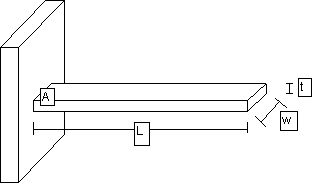
1) Cantilever Beam: A beam fixed at one end and free at the other end is known as cantilever beam.
2) Simply Supported beam : A beam supported at its both end is known as simple supported beam.
3) Overhanging beam: A beam having its end portion extended beyond the support is known as overhanging beam. A beam may be overhanging on one or both side.
4) Fixed Beams: A beam whose both ends are fixed is known as fixed beams.
5) Continuous beam: A beam supported on more than two supports is known as continuous beam.
1) Cantilever Beam: A beam fixed at one end and free at the other end is known as cantilever beam.
2) Simply Supported beam : A beam supported at its both end is known as simple supported beam.
3) Overhanging beam: A beam having its end portion extended beyond the support is known as overhanging beam. A beam may be overhanging on one or both side.
4) Fixed Beams: A beam whose both ends are fixed is known as fixed beams.
5) Continuous beam: A beam supported on more than two supports is known as continuous beam.
Projectile
A particle which is moving under the combined effect of vertical and horizontal forces is called Projectile.
Following terms are used in projectile:
1) Trajectory: It is the path traced by a projectile in the space.
3) Velocity of projection: It is the velocity with which a projectile is prjected.
3) Angle of projection: It is the angle, with the horizontal, at which the projectile is projected.
4) Time of flight: It is the total time taken by a projectile, to reach maximum height and to return back to the ground.
Range: It is the distance between the point of projection and the point where the projectile strikes the ground.
Equation of Path of Projectile
Let
O = point of projection
v= velocity of projection
Alpha = Angle of projection with the horizontal
After time t , The equation of the path of [projectile or the equation of trajectory is given by
y= xtan(alpha) - (gx^2/2u^2cos^2alpha)
1) Time of flight (t)= (2usin(alpha)/g)
2) Range (R) = (u^2sin2(alpha) / g)
3) Maximum Height (H) = u^2 sin^2alpha / 2g
Following terms are used in projectile:
1) Trajectory: It is the path traced by a projectile in the space.
3) Velocity of projection: It is the velocity with which a projectile is prjected.
3) Angle of projection: It is the angle, with the horizontal, at which the projectile is projected.
4) Time of flight: It is the total time taken by a projectile, to reach maximum height and to return back to the ground.
Range: It is the distance between the point of projection and the point where the projectile strikes the ground.
Equation of Path of Projectile
Let
O = point of projection
v= velocity of projection
Alpha = Angle of projection with the horizontal
After time t , The equation of the path of [projectile or the equation of trajectory is given by
y= xtan(alpha) - (gx^2/2u^2cos^2alpha)
1) Time of flight (t)= (2usin(alpha)/g)
2) Range (R) = (u^2sin2(alpha) / g)
3) Maximum Height (H) = u^2 sin^2alpha / 2g
Friday, September 15, 2017
WHAT ARE THE MOST SEARCHED THING ON GOOGLE ?
1) POLITICAL PERSONS and POLITICAL NEWS
People from all around the world are interested in politics of their own country as well as of other countries. So, search of politics is common. Some of the most searched things are:
2) CELEBRITIES
People follow their loved ones. They always like to read about them and get inspired by their work.
Some of the most searched personalities are:
People search the products they want and always look for the best option by looking their reviews, specifications and price. Top products searched are:
People from all around the world are interested in politics of their own country as well as of other countries. So, search of politics is common. Some of the most searched things are:
- TRUMP
- VLADIMIR PUTIN
- KIM JONG UN
- NARENDRA MODI
- US ELECTION
- WAR AT MIDDLE EAST
2) CELEBRITIES
People follow their loved ones. They always like to read about them and get inspired by their work.
Some of the most searched personalities are:
- Leonardo DiCaprio
- Meghan Markle
- Beyoncé
- Brad Pitt
- Tom Hiddleston
- Meghan Markle
- Marion Cotillard
- Amir, Salman, Sharukh Khan
- Indian Actresses
- Name of the recent films
3) SPORTS PERSON AND STATS
People follows their sports idol. Football is most searched, then comes rugby, basketball and cricket and the stats of the games, players and their ranking.
Some of the person are :
- Messi
- Ronaldo
- Coutinho
- Neymar
- Kevin Durant
- Michael Phelps
- Steph Curry
- Virat Kholi
- AB devilliars
- Stats about the players
4) PRODUCTS and INFO
People search the products they want and always look for the best option by looking their reviews, specifications and price. Top products searched are:- Mobile
- Iphone
- Laptops
- Games
- Books
- Software and apps
- Other gadgets
(*The list provided above are not the ranking. )
Wednesday, September 13, 2017
Role of Engineer in Local Infrastructure Development
1) GUARANTEE BUILDING RESILIENCE
2) PLANNING LOCAL PROJECTS
3) DRM STRATEGIES AT LOCAL LEVEL
4) RESEARCH, TRAINING AND LEADERSHIP
5) UPLIFT ECONOMY
2) PLANNING LOCAL PROJECTS
3) DRM STRATEGIES AT LOCAL LEVEL
4) RESEARCH, TRAINING AND LEADERSHIP
5) UPLIFT ECONOMY
Subscribe to:
Posts (Atom)